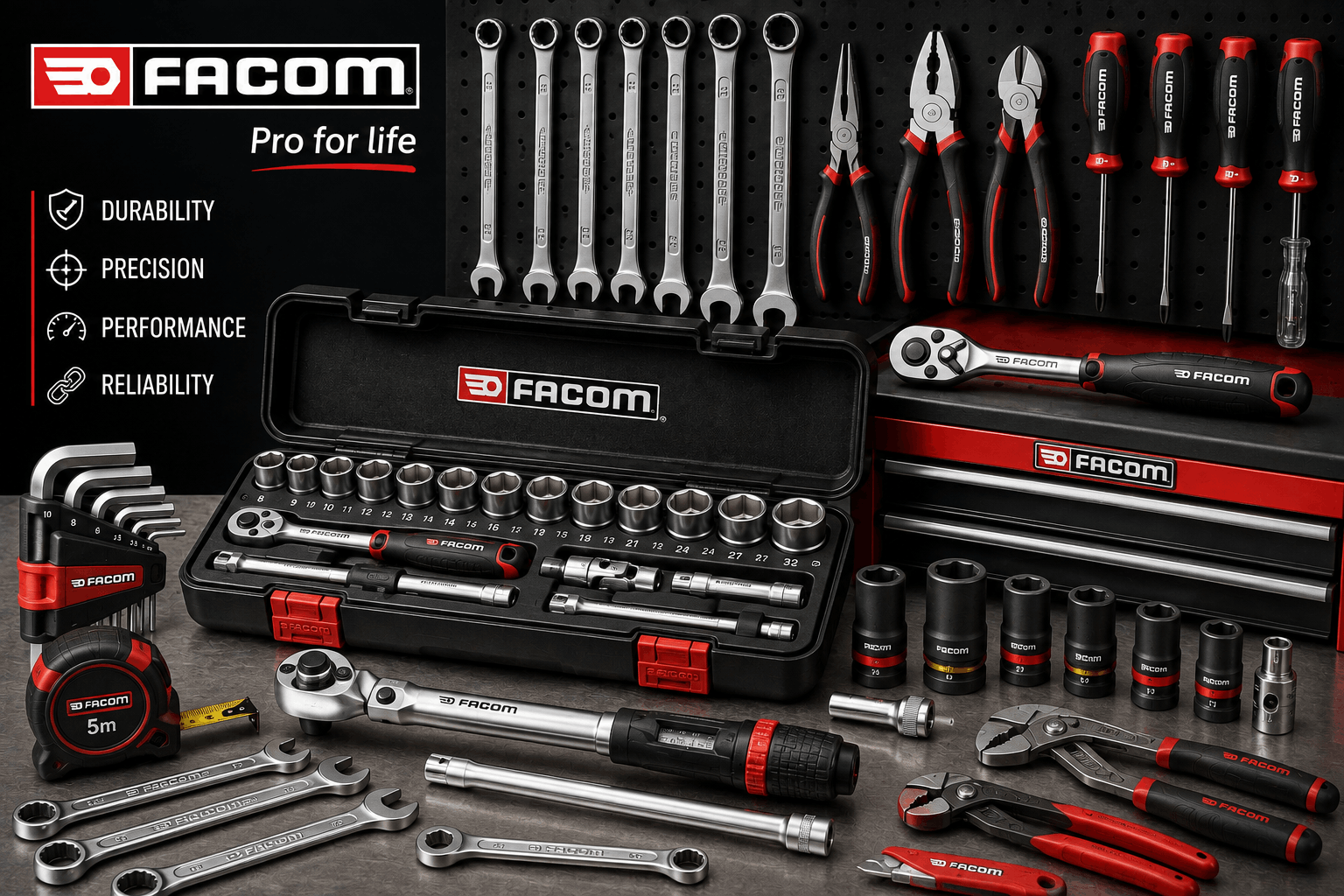
A well-equipped workshop depends on more than having a large collection of tools. The equipment needs to be appropriate for the work being undertaken, comfortable to use and capable of delivering consistent performance. For mechanics, engineers and maintenance professionals, even relatively simple hand tools may be subjected to significant forces every working day, making careful tool selection particularly important.
When researching Facom Tools, users will find equipment covering general mechanical work, vehicle maintenance, engineering and specialist workshop applications. Building an effective toolkit usually starts with frequently used essentials such as sockets, ratchets, spanners, screwdrivers and pliers before expanding into torque equipment and specialist tools according to the work being performed.
Starting with a Quality Socket Set
A socket set is one of the foundations of a mechanical toolkit. Sockets provide secure contact with nuts and bolts while ratchet handles make repetitive fastening considerably quicker than conventional spanners in many situations.
Different drive sizes are designed for different applications. Smaller drives are compact and useful for lighter fasteners or confined spaces, while larger drives are generally better suited to applications requiring greater torque.
A useful socket collection should reflect the machinery or vehicles being maintained. Buying dozens of unusual sizes that are rarely used offers little practical advantage compared with having dependable versions of the sizes required every day.
Deep sockets can also be valuable where a standard socket cannot reach a nut positioned on a long thread. Extension bars, universal joints and flexible accessories further increase the number of locations that can be reached with a conventional ratchet.
Why Ratchet Design Matters
Not all ratchets operate in exactly the same way. The internal mechanism determines how far the handle must move before the next tooth engages.
Fine-tooth ratchets can be particularly useful inside engine compartments, machinery and other confined areas because they require a relatively small working arc. This can allow fasteners to be removed in spaces where a conventional ratchet would be difficult to operate.
Handle length is another consideration. Longer handles provide additional leverage, while shorter ratchets improve access. Professional mechanics commonly have several configurations available rather than expecting one ratchet to perform every task.
Spanners Remain Workshop Essentials
Despite the versatility of socket sets, spanners remain indispensable. There are many situations where access prevents a socket from being positioned correctly.
Combination spanners provide an open end alongside a ring end, giving users two approaches to the same fastener size. Ring ends generally provide greater contact around the fastener, while open ends can offer easier access.
Ratcheting spanners add another useful option. Their internal mechanisms allow fasteners to be turned without repeatedly removing the tool, which can significantly improve efficiency during repetitive work.
Understanding Torque Wrenches
Many automotive and engineering components require precise tightening rather than simply being made as tight as possible.
A torque wrench allows the user to apply a specified amount of rotational force. Correct torque can be particularly important for components such as wheels, engine assemblies and other mechanically critical fasteners.
Different torque ranges require different tools. A wrench intended for high-torque applications may not provide appropriate accuracy for delicate components requiring much lower values.
Torque tools should also be treated as precision instruments. Appropriate storage, careful use and periodic checking or calibration help maintain reliable performance.
Screwdrivers and Driver Tools
Screwdrivers remain among the most frequently used tools in any workshop. Modern vehicles and machinery can contain numerous fastener profiles, making a varied driver collection essential.
Slotted, Phillips, Pozidriv, Torx and hex profiles are commonly encountered. Using the correct profile and size provides better engagement and reduces the risk of damaging the fastener.
Handle ergonomics become particularly important when screwdrivers are used repeatedly. A secure, comfortable grip helps transfer force effectively while reducing fatigue during longer jobs.
Pliers, Cutters and Gripping Equipment
Pliers cover an enormous range of workshop tasks. Combination pliers provide everyday versatility, while long-nose versions help reach small components in confined areas.
Side cutters are designed specifically for cutting suitable wire, while circlip pliers provide the control required for removing and installing retaining rings.
Locking and adjustable pliers can provide powerful gripping capability, although they should not routinely replace correctly sized spanners when working with conventional nuts and bolts.
Breaker Bars for Stubborn Fasteners
Corroded or heavily tightened fasteners sometimes require substantially more leverage than an ordinary ratchet should provide.
A breaker bar is designed specifically for this purpose. Its long handle allows additional force to be applied without placing excessive load through a ratchet mechanism.
Once the fastener has been loosened, a ratchet can normally be used to complete removal more efficiently.
Specialist Automotive Tools
General-purpose equipment will handle many maintenance tasks, but specialist tools become increasingly important as repairs become more complex.
Brake servicing, bearing removal, suspension work, trim removal and engine maintenance can all require purpose-designed equipment. Using the correct specialist tool can save considerable time while reducing the likelihood of damaging components.
This is particularly relevant to modern vehicles, where plastic connectors, clips, electronic systems and precisely engineered components can be damaged relatively easily through inappropriate methods.
Workshop Organisation and Storage
As a tool collection expands, organisation becomes increasingly important. A professional technician may eventually own hundreds of individual pieces of equipment.
Tool cabinets and drawer systems allow equipment to be arranged logically. Sockets might occupy one drawer, spanners another and specialist automotive equipment another, making tools quicker to locate.
Fitted trays can improve organisation further by providing a dedicated location for each tool. An empty position immediately indicates that something has not been returned.
This is particularly useful in automotive and engineering environments, where leaving a tool inside machinery can have serious consequences.
Looking After Professional Tools
Even durable professional equipment benefits from basic maintenance. Tools exposed to oil, grease, moisture or chemicals should be cleaned before being returned to storage.
Ratchets and other mechanisms should be inspected periodically, while worn or damaged tools should be removed from use.
Corrosion can also be reduced by storing equipment somewhere dry rather than leaving tools exposed in damp workshops, vans or garages.
Don't Use Tools for the Wrong Job
One of the easiest ways to damage equipment is to use it for a purpose for which it was never designed.
Screwdrivers should not routinely become pry bars, torque wrenches should not replace breaker bars and ordinary sockets should not automatically be used with high-powered impact equipment.
Selecting the correct tool protects both the equipment and the component being worked on.
Building a Toolkit Gradually
There is rarely a need to purchase an entire professional workshop collection at once. A more practical approach is to begin with the tools used most frequently and expand the collection as genuine requirements arise.
A good socket set, combination spanners, screwdrivers, pliers, cutters and measuring equipment provide an excellent foundation.
Torque tools and specialist automotive equipment can then be added according to the type of work being undertaken.
Professional technicians may also find that their requirements change throughout their careers. Someone moving from general servicing into diagnostics, restoration or specialist engineering may gradually require completely different equipment.
Considering Long-Term Value
Purchase price is only one measure of tool value. Accuracy, durability, ergonomics, replacement availability and frequency of use should all influence buying decisions.
A tool used several times every working day may justify considerably greater investment than something required once or twice each year.
For professional users, reliability can also directly affect productivity. A failed tool can interrupt work, delay a repair and potentially leave expensive workshop time unused.
Ultimately, Facom Tools provide options for building professional mechanical, automotive and engineering toolkits around the tasks users actually perform. By combining quality sockets, ratchets, spanners and screwdrivers with appropriate torque equipment, specialist tools and organised storage, mechanics and engineers can create an efficient workshop setup designed to support accurate and dependable work for many years.